

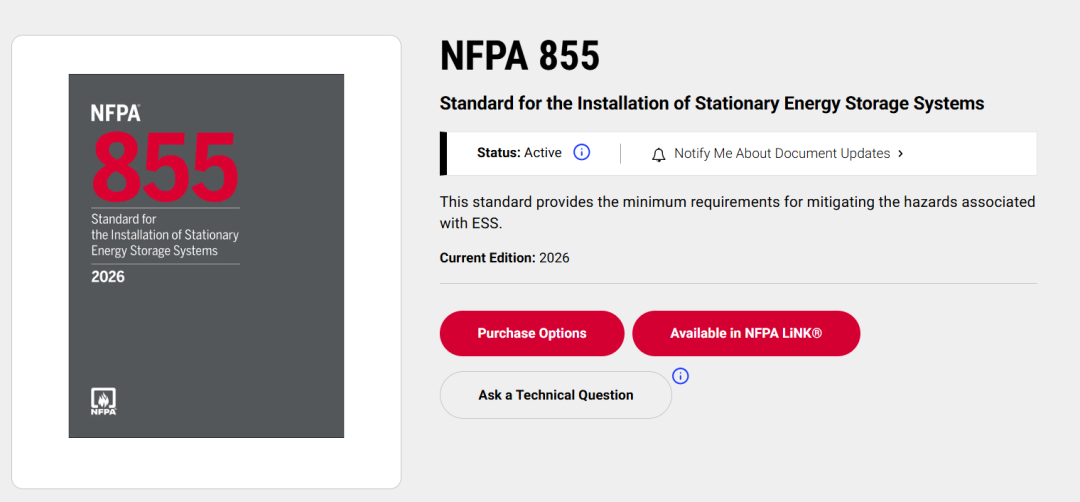
近日,新版NFPA 855《固定式储能系统安装标准》(2026版本)已在NFPA官网发布,每三年更新一次,规定了住宅、商用、工业及公用事业级储能的最低安装要求。其建议已被多个美国州、监管机构、金融和保险机构采纳,并在国际上作为最佳实践参考。

详情
NFPA 855《固定式储能系统安装标准》深入阐述了风险管控措施,在充分考虑关键生命安全要素的前提下,确保所有安装作业规范实施。该标准针对能源存储系统(ESS)安装的防火保护制定了全面标准,涵盖技术类型、安装环境、ESS规模与间距、以及现有灭火控制系统等要素。
为应对国际储能系统火灾事件,增加了或修订了火灾探测与灭火、防爆控制、排风通风、气体探测和热失控的要求。明确了火灾与爆炸测试(正式的大规模火灾测试)的要求。
重点内容
2026版进行了重大修订,包含以下更新:
适用于所有储能系统的通用要求已整合至第4章,而各储能技术专项要求则收录于对应章节。
新增了多种电池类型。
针对所有铅酸电池、水系镍基电池及水系金属空气电池,进一步细化了各类电池的豁免条款。
新增应急响应计划要求、含储能功能的电动汽车充电系统规范、第16章流动电池专章及第17章驳船式储能系统专章。
修订附录G.8节关于锂离子储能系统NFPA 69评估内容,提供工程设计与风险缓解考量,以辅助评估爆炸事件后果。
新版增加了大规模火灾测试(LSFT),即在关闭灭火设备情况下故意点燃整套系统,以模拟最极端场景。

2026版目录详情
NFPA 855 Standard for the Installation of Stationary Energy Storage Systems 2026 Edition®
Chapter 1 Administration1.1 Scope.
1.2 Purpose.
1.3 Application.
1.4 Retroactivity.
1.5 Equivalency.
1.6 Units and Formulas.
Chapter 2 Referenced Publications
2.1 General.
2.2 NFPA Publications.
2.3 Other Publications.
2.4 References for Extracts in Mandatory Sections.
Chapter 3 Definitions
3.1 General.
3.2 NFPA Official Definitions.
3.3 General Definitions.
Chapter 4 General
4.1 General.
4.2 Construction Documents.
4.3 Emergency Planning and Training.
4.4 Hazard Mitigation Analysis (HMA).
4.5 Combustible Storage.
4.6 Equipment.
4.7 Installation.
4.8 Smoke and Fire Detection.
4.9 Fire Control and Suppression.
4.10 Emergency Power Supply Systems (EPSS).
4.11 Critical Safety System Control and Power.
4.12 Vehicle to Grid (V2G) Usage.
4.13 Electric Vehicle Charging Systems.
4.14 Mobile ESS Equipment and Operations.
Chapter 5 System Interconnections
5.1 General.
5.2 Disconnecting Means.
5.3 Nonelectrical Systems.
5.4 Support Systems.
Chapter 6 Commissioning
6.1 System Commissioning.
6.2 Issues and Resolutions Documentation. (Reserved)
6.3 Operations and Maintenance Documentation.
6.4 Recommissioning of Existing Systems.
Chapter 7 Operation and Maintenance
7.1 System Operation.
7.2 System Maintenance.
7.3 System Testing.
Chapter 8 Decommissioning
8.1 Decommissioning Plan.
8.2 Decommissioning Process.
8.3 Decommissioning Report.
Chapter 9 Electrochemical Energy Storage Systems
9.1 General.
9.2 Fire and Explosion Testing.
9.3 Equipment.
9.4 Location Classification.
9.5 Installation.
9.6 Location and Applications.
9.7 Protection and Remediation.
Chapter 10 (Reserved)
Chapter 11 Fuel Cell Energy Storage Systems
11.1 Installation and Maintenance.
11.2 Fuel-Cell-Powered Vehicle Use.
Chapter 12 Superconducting Magnet Energy Storage (Reserved)
Chapter 13 Flywheel Energy Storage Systems (FESSs)
13.1 Application.
13.2 Protection Features.
13.3 Commissioning.
13.4 Operation and Maintenance.
13.5 Decommissioning.
Chapter 14 Storage of Lithium Metal or Lithium-ion Batteries
14.1 Batteries.
14.2 Collection Locations.
14.3 Indoor Storage Locations.
14.4 Prevention and Mitigation.
14.5 Explosion Protection.
14.6 Outdoor Storage Location.
Chapter 15 One- and Two-Family Dwellings and Townhouse Units1
5.1 General.
15.2 Equipment Listings.
15.3 Installation.
15.4 Locations.
15.5 Energy Ratings.
15.6 Electrical Installation.
15.7 Fire Detection.
15.8 Protection from Vehicle Damage.
15.9 Exhaust Ventilation.
15.10 ESS Toxic and Highly Toxic Gas Release During Normal Use.
15.11 Electric Vehicle Use.
15.12 Test Reports.
15.13 Fire and Explosion Testing.
Chapter 16 Flow Batteries
16.1 General.
16.2 Hazard Mitigation Analysis.
16.3 Operation and Maintenance.
16.4 Decommissioning.
16.5 Fire Control and Suppression.
16.6 Spill Control.
16.7 Hazard Support Personnel.
16.8 Installation.
Chapter 17 Energy Storage Systems on Barges and Vessels
17.1 Application.
17.2 Commissioning, Recommissioning, and Decommissioning.
17.3 Operations and Maintenance.
17.4 Emergency Planning and Training.
17.5 Locations, Anchoring, and Securement.
17.6 Electrical Connections.
17.7 Marine Environment.
17.8 Smoke and Fire Detection.
17.9 Fire Control and Suppression.
17.10 Fire Protection and Construction for Marinas and Boatyards.
17.11 Multi-Leveled and Stacked Barges.
Annex A Explanatory Material
Annex B Battery Energy Storage System Hazards
Annex C Firefighting Considerations (Operations)
Annex D Overview of Energy Storage Systems Technologies
Annex E Permits, Inspections, Approvals, and Connections
Annex F Fire and Building Codes A Short History on Stationary Storage Battery Systems
Annex G Guide for Suppression and Safety of Lithium-Ion Battery (LIB) Energy Storage Systems (ESSs)
Annex H Informational References
原文首发于公众号「华慧防火技术研究」,查看原文